
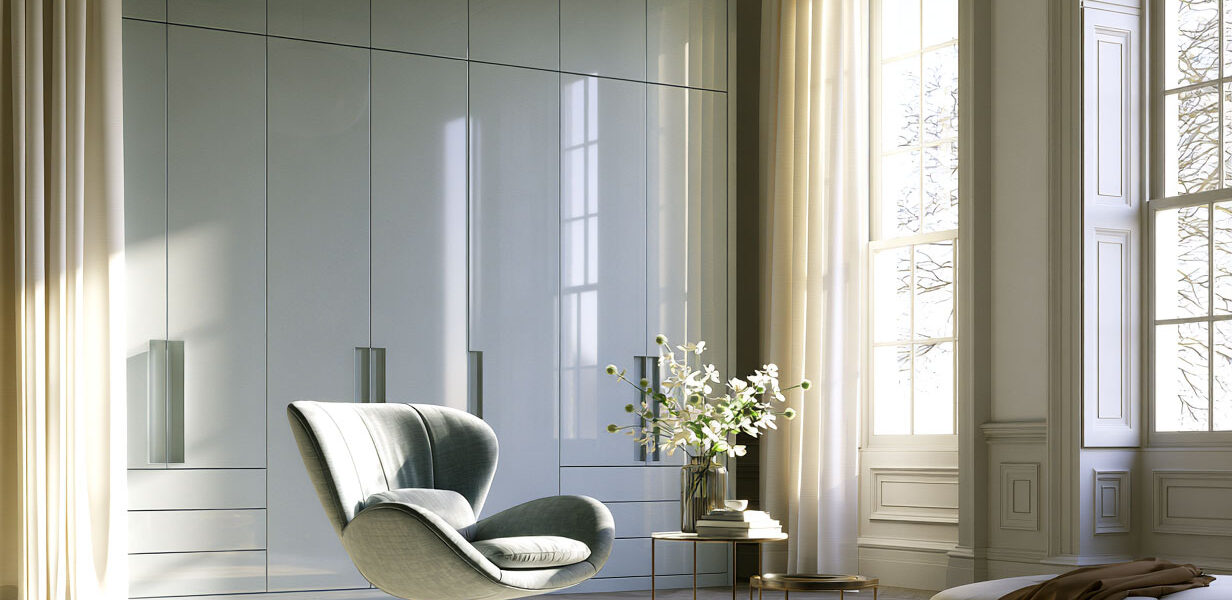
The most effective fitted wardrobes do more than hide clothes. They remove small points of friction from your morning, protect valuable floor space, and give every item a logical home.
Unlike freestanding furniture, fitted wardrobes can follow the exact height, width, and shape of a bedroom. That makes them especially useful around chimney breasts, sloping ceilings, alcoves, and uneven walls. The real advantage, however, comes from designing the inside around how you live.
Quick Facts About Fitted Wardrobes
| Question | Practical answer |
|---|---|
| What are fitted wardrobes? | Permanently installed wardrobes designed to fit a specific wall or bedroom space. |
| What is their main benefit? | They convert awkward or unused areas into organised bedroom storage. |
| Are they suitable for small bedrooms? | Yes, provided door clearance, walking space, and internal depth are planned correctly. |
| Should the inside or outside be designed first? | Plan the internal storage first, then choose doors, colours, and handles. |
| Do fitted wardrobes add property value? | They do not guarantee a higher valuation, but good storage can improve buyer appeal. |
| What should be measured? | Measure the wall’s width, height, and depth in several places. |
| What affects the price? | Size, materials, door type, internal fittings, lighting, and installation complexity. |
| Are sliding doors always better? | No. They save opening space but restrict access to part of the wardrobe. |
| What is the best design for long-term use? | A neutral exterior with adjustable shelves, rails, and replaceable internal fittings. |
Why Fitted Wardrobes Make Daily Life Easier
A well-designed wardrobe shortens the distance between storing, finding, and wearing your clothes. Shirts sit at eye level. Shoes have a defined section. Everyday items remain within easy reach.
This sounds simple, but many wardrobes are designed backwards. Homeowners often choose attractive doors first and then divide the remaining space into generic shelves.
Which? recommends assessing what you need to store before creating the internal layout. Its guidance suggests planning for long garments, shoes, folded clothes, bags, and future storage needs before selecting the exterior style.
From a property analyst’s perspective, that inside-first approach protects the usefulness of the investment. Decorative finishes may date, but a flexible internal system can continue working for years.
Storage Should Follow Your Routine
Start by listing what you use each week. Separate those items from occasional, formal, and seasonal clothing.
Your prime storage zone should contain the items you reach for most often. This normally means placing daily clothing between waist and eye level.
Less frequently used items can sit higher. Heavy objects should remain lower, where they are easier and safer to handle.
A practical wardrobe might include:
- Double hanging rails for shirts, jackets, and trousers
- Full-height hanging space for dresses and long coats
- Shallow drawers for underwear and accessories
- Adjustable shelves for knitwear and folded clothes
- Pull-out storage for shoes, belts, or bags
- High cupboards for luggage and seasonal bedding
- A defined space for clothes that will be worn again
The last section is frequently overlooked. Without it, lightly worn clothes often end up on chairs, beds, or door hooks.
If you are in a rental apartment and can’t make major adjustments, be sure to look for current arrangements and check whether they fit your needs. For instance, in a high-quality, purpose-designed student flat, you can find functional solutions that add storage without affecting living space. Look for these features when viewing apartments to rent!
Measure the Bedroom Before Designing the Wardrobe
Accurate measurement is the foundation of fitted furniture. Do not assume the ceiling, floor, or walls are level.
Which? advises measuring the width and height in three locations because walls may be uneven. It also recommends recording fixed obstacles such as sockets, radiators, and light switches.
Measure:
- Floor-to-ceiling height at both ends and in the centre
- Wall-to-wall width at the top, middle, and bottom
- Available wardrobe depth
- Skirting-board depth
- Door and window clearance
- Radiator, switch, and socket positions
- Ceiling slopes, beams, alcoves, and chimney breasts
- The walking distance between the wardrobe and bed
Use the smallest reliable measurement when planning the main structure. The installer can then use fillers, scribes, plinths, and trims to close irregular gaps.
Test the Wardrobe Footprint First
Mark the proposed wardrobe depth on the floor with painter’s tape. Mark the door swing as well.
This low-cost test reveals whether the room will still feel comfortable. It can also show whether drawers will collide with the bed or bedside furniture.
IKEA’s planning guidance similarly recommends measuring height, width, and depth while accounting for radiators, pipes, recesses, and sloping ceilings. It also advises checking that hinged doors can open fully.
Choose the Right Wardrobe Depth
Wardrobe depth affects storage capacity and bedroom movement. A deep wardrobe may provide more hanging space, but it can overwhelm a narrow room.
As a useful reference point, IKEA’s PAX system offers frames at 35cm and 58cm deep. These are modular product dimensions rather than universal fitted-wardrobe standards.
A shallow wardrobe may work for folded clothing, shoes, accessories, or front-facing hanging rails. Standard side-facing clothes hangers usually need more depth.
Before approving a reduced-depth design, check the actual width of your hangers and garments. Thick coats need more room than shirts.
Avoid Deep, Unreachable Shelves
A large shelf is not always useful storage. Deep shelves often allow items to disappear behind one another.
Use pull-out trays, baskets, or drawers where visibility matters. Fixed deep shelves are better reserved for labelled boxes, bedding, or luggage.
From an asset-efficiency perspective, usable capacity matters more than gross capacity. Storage that cannot be reached comfortably has little practical value.
Sliding Doors or Hinged Doors?
Door choice should depend on room geometry, not fashion.
Sliding doors require no outward opening area. This can help when the wardrobe sits close to a bed or narrow walkway.
However, sliding panels overlap. You cannot view or access the full wardrobe at once.
Which? notes that homeowners sometimes choose sliding doors to save space, only to discover that half the wardrobe remains covered at any given time. Hinged doors require enough space for the door and the person using it.
Choose Sliding Doors When
Sliding doors can work well when:
- The gap between the bed and wardrobe is limited
- Full door swing would block a walkway
- You want broad mirrored panels
- The internal sections align with the door openings
Choose Hinged Doors When
Hinged doors are often more practical when:
- You want to view the full wardrobe
- You use door-mounted mirrors or organisers
- Drawers need unrestricted access
- The bedroom has sufficient clearance
- Individual doors may need easier future replacement
Bi-fold doors can offer a middle ground in awkward rooms. Their tracks and hinges should be assessed for durability and ease of repair.
Customise the Interior Around Your Clothes
Before meeting a designer, count what you own.
Record the approximate number of shirts, dresses, trousers, shoes, bags, folded items, and storage boxes. Measure your longest garment.
IKEA’s capacity guidance gives useful reference heights. It allows roughly 80cm for shirts, 100cm for coats, 120cm for short dresses, and up to 190cm for very long garments. These are planning guides, not mandatory dimensions.
Use Double Hanging Space Carefully
Double rails can greatly increase capacity for short garments. They work well for shirts, blouses, jackets, and folded trousers.
Do not use double rails across the entire wardrobe unless your clothing supports it. Preserve some full-height hanging space for dresses, long coats, and formalwear.
Install Drawers Where You Can See Them
Drawers are most useful below eye level. Very low drawers may require repeated bending, while high drawers can be difficult to inspect.
Shallow drawers are ideal for small items. Deep drawers suit knitwear, sleepwear, or sports clothing.
Soft-close runners can improve daily use. More importantly, choose hardware that can be adjusted or replaced without dismantling the whole wardrobe.
Keep Shelves Adjustable
Fixed shelves make sense when they support the structure. Other shelves should remain adjustable where possible.
Your storage needs may change with work, family life, or clothing habits. Adjustable fittings protect the wardrobe from becoming obsolete.
This adaptability is important financially. A flexible system can serve more occupants and is less dependent on one owner’s routine.
Use Awkward Bedroom Areas Properly
Fitted wardrobes are most valuable where standard furniture performs poorly. They can fill narrow alcoves, bridge chimney breasts, follow sloping ceilings, or extend above doorways. This is particularly useful in period properties, where homeowners considering fitted wardrobes in Wimbledon may need made-to-measure storage that respects Victorian or Edwardian proportions while using awkward bedroom space efficiently.
Which? identifies small and awkward rooms as strong candidates for fitted storage. It cautions that doors and drawers must still open properly and that small internal compartments must remain useful.
Sloping Ceilings
Use the tallest section for hanging clothes. Lower sections can hold drawers, shoes, baskets, or folded items.
Avoid dividing the slope into too many tiny cupboards. Small doors, hinges, trims, and internal corners can raise costs without adding meaningful capacity.
Chimney Breasts and Alcoves
A wardrobe can sit inside each alcove or span the full wall. The correct choice depends on room proportions and storage needs.
A full-wall design creates a cleaner visual line. Separate alcove units may retain more character in a period bedroom.
Over-Bed Storage
Cabinets above a bed can add capacity, but they require careful design. The structure must be secure and should not make the sleeping area feel enclosed.
Keep frequently used items elsewhere. Over-bed cupboards are better for lightweight, occasional storage.
Make the Wardrobe Visually Calm
Large fitted wardrobes occupy significant wall area. Their finish can change how the entire bedroom feels.
Light neutrals can reduce visual weight. Painting doors close to the wall colour can create a more continuous surface.
Mirrored doors reflect light and remove the need for a separate full-length mirror. They also show fingerprints and may create unwanted reflections at night.
Wood veneer adds warmth and texture. Painted MDF offers broad colour choice and can be refreshed, although painted surfaces may need occasional touch-ups.
Choose a Style That Can Age Well
Highly distinctive colours and ornate details may suit your home perfectly. They may also narrow future buyer appeal.
For long-term flexibility, consider neutral doors with replaceable handles. Hardware can change the character of a wardrobe without replacing its main structure.
This follows the same principle used in property investment. Spend heavily on durable infrastructure, then use lower-cost elements for personal expression.
Lighting That Improves Everyday Use
Internal lighting makes dark shelves and drawers easier to use.
Door sensors can switch lights on automatically. This is useful when two people have different morning routines.
Place lighting near the front of each section. A single light at the top may leave lower drawers in shadow.
Integrated electrical work should be planned before installation. Cables, drivers, switches, and access panels should remain reachable for repair.
Ventilation and Moisture Need Attention
Fitted wardrobes can restrict airflow, especially when installed against cold external walls.
Local authority guidance identifies poorly ventilated spaces behind wardrobes as common locations for condensation and mould. External walls and corners can be particularly vulnerable.
Before installation, investigate existing damp, leaks, or mould. Do not cover the problem with cabinetry.
The designer may recommend ventilation gaps, grilles, an open plinth detail, or space behind the unit. The correct solution depends on the wall construction and moisture source.
Maintain normal room ventilation after installation. Wardrobe doors should also be opened regularly where clothing or shoes may hold moisture.
Safety and Installation Quality
A fitted wardrobe is only as reliable as its fixing method.
Installers must select fixings for the actual wall type. Plasterboard, masonry, timber studs, and older walls require different approaches.
BS EN 15939 provides testing methods for the loading capacity of wall-attachment hardware used with storage furniture. However, the standard also notes that the fixing into the building wall is outside its scope.
That distinction matters. Strong brackets cannot compensate for unsuitable wall plugs or weak substrate.
Ask the installer:
- How will the wardrobe be secured?
- What wall type was identified?
- Are the shelves and rails load-rated?
- Can hinges and runners be adjusted?
- How are electrical components accessed?
- What happens if the floor settles?
- What workmanship and hardware guarantees apply?
Do Fitted Wardrobes Add Value to a Home?
Fitted wardrobes do not automatically increase a property’s formal valuation. Their strongest financial contribution is usually improved usability and buyer confidence.
In its 2026 fitted-wardrobe research, Which? reported that estate agents viewed storage as helpful for presenting a principal bedroom. They did not treat fitted wardrobes as a guaranteed value-adding renovation.
The best property case exists when the wardrobe solves a visible problem. Examples include a room with no suitable freestanding wall, an awkward alcove, or restricted floor space.
A neutral, well-built wardrobe may also remove a future buyer’s concern about finding suitable storage. A highly personalised layout may have the opposite effect.
Treat It as a Lifestyle Investment First
Do not install expensive fitted wardrobes immediately before selling solely to recover the cost.
Install them because they will improve the home while you live there. Any future buyer appeal should be treated as a secondary benefit.
This is consistent with sound property strategy. Improvements deliver the strongest value when they combine daily utility, durable construction, and broad market relevance.
Fitted Wardrobe Costs and Budget Priorities
Costs vary widely because fitted wardrobes are not one standard product.
Which?’s 2026 analysis identifies size, materials, interior fittings, doors, hardware, and installation complexity as major cost drivers. Sloping ceilings and uneven rooms generally require more labour.
Modular systems sit at the lower end of the market. Which? reported starting prices of about £100 for some PLATSA arrangements and £250 for PAX configurations, before considering the final layout and installation.
Fully bespoke joinery can cost much more. It may include site measurement, design work, custom manufacturing, finishing, delivery, and fitting.
Prioritise spending in this order:
- Accurate measurement and design
- Strong carcasses and secure installation
- Reliable hinges, runners, and tracks
- A practical internal layout
- Durable doors and finishes
- Decorative accessories
A beautiful door cannot rescue an inconvenient interior.
Fitted Wardrobe Planning Checklist
Before placing an order, confirm that:
- The room was measured in several locations
- Radiators, switches, sockets, and pipes are recorded
- Door and drawer clearance has been tested
- The layout reflects your actual clothing
- Some shelves or rails can be adjusted
- Long garments have enough height
- Daily items remain easy to reach
- Awkward compartments are still usable
- Damp or ventilation concerns were investigated
- Lighting components can be serviced
- Wall fixings match the wall construction
- The quotation includes fitting, hardware, finishing, and VAT
- Guarantees and payment terms are written clearly
Frequently Asked Questions
Are fitted wardrobes good for small bedrooms?
Yes. Fitted wardrobes can use the full wall height and fill spaces that freestanding furniture cannot. The design must still preserve walking room, door clearance, drawer access, and enough internal depth for your clothes.
Should fitted wardrobes go to the ceiling?
Floor-to-ceiling wardrobes maximise vertical storage and reduce dust-collecting gaps. The highest cupboards work best for seasonal or occasional items. The design should also account for uneven ceilings, cornices, lighting, and access.
Are sliding wardrobes better than hinged wardrobes?
Neither option is universally better. Sliding doors save floor space but limit access to part of the wardrobe. Hinged doors provide a wider view but require clear opening space in front.
What should go inside a fitted wardrobe?
Include a balance of short hanging space, long hanging space, drawers, adjustable shelves, and high-level storage. Add specialist fittings only when they match items you actually own.
Can fitted wardrobes cause damp?
They do not create damp by themselves. However, a large unit can restrict airflow against a cold or already damp wall. Existing moisture problems should be investigated before installation, with ventilation considered during design.
Do fitted wardrobes add value to a house?
They may improve buyer appeal, particularly when they solve a storage problem. However, there is no guaranteed increase in valuation. Their main return is better organisation and more efficient use of the bedroom.
How long should fitted wardrobes last?
There is no fixed lifespan. Durability depends on materials, installation, hardware quality, loading, moisture exposure, and maintenance. Replaceable hinges, runners, handles, and adjustable fittings can extend practical life.
Final Verdict
The best fitted wardrobes are designed from the inside out.
They reflect what you own, how you get dressed, and how the bedroom is used. They also leave enough flexibility for your needs to change.
From a property perspective, the strongest design is rarely the most elaborate. It is the one that converts difficult space into durable, accessible, and visually calm storage without reducing the room’s comfort.