
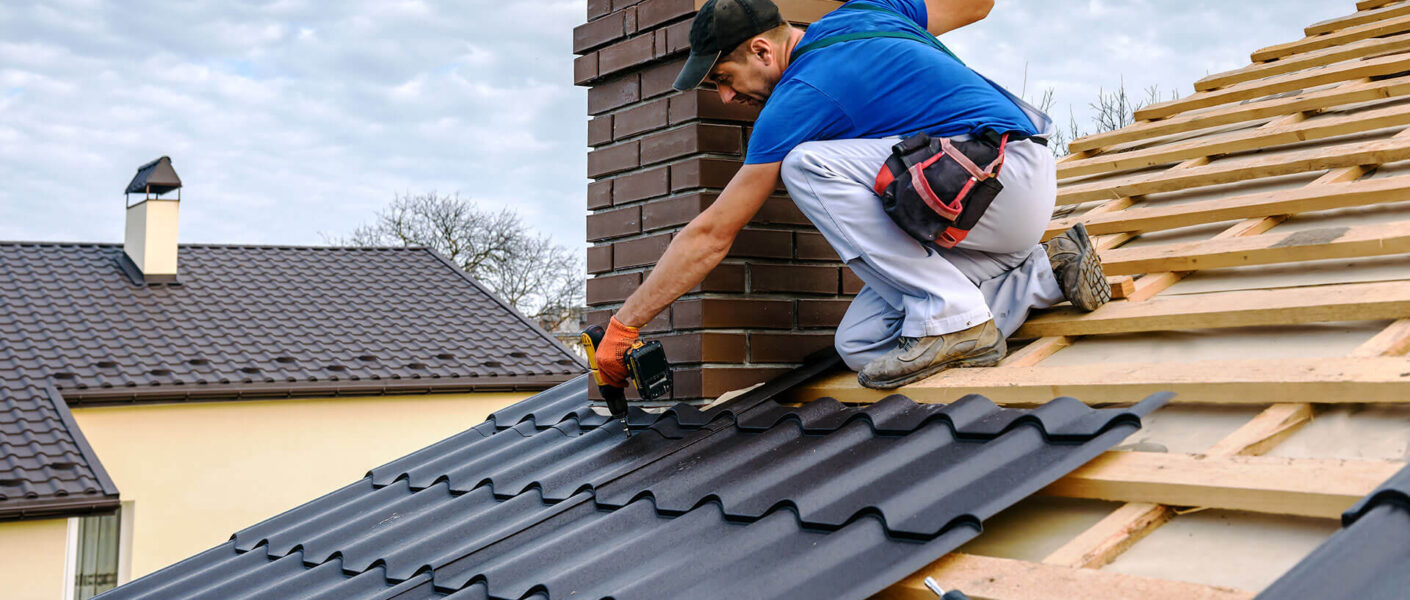
The question comes up constantly: keep repairing the existing roof, or start over entirely? The answer depends on a few things—how old the roof is, what’s happening beneath the surface, and whether the money already spent on repairs has bought anything lasting. Work through those, and the decision usually becomes clearer than it feels at the start.
How to Tell When Repairs Have Stopped Working
Not every roof problem needs a full replacement. A cracked ridge tile or a handful of slipped slates is a roof repair job—cheap, quick, and no sensible roofer would pull off a sound roof because a few components have given out.
That changes when you’re having the same conversation every six months. If different sections are failing in rotation, or you’ve had three call-outs in a single year and the leaks keep reappearing, you’re not dealing with isolated faults. You’re dealing with a roof wearing out all at once. The tiles, the felt underneath, the battens, the ridge pointing—none of it lasts forever, and it doesn’t always fail in sequence. When the whole system starts to go, each repair is just a holding action.
The cost trap: Two or three £300–£400 jobs spaced over eighteen months might feel manageable. Add them up, and you’ve spent close to £1,000 on a roof with no guarantee it’ll hold through the next winter. That money doesn’t disappear—it could have gone toward a permanent fix.
Age Is the Number You Need to Know
Before anything else, find out how old your roof is. If it’s not in your conveyancing paperwork, an experienced roofer can usually estimate it from the materials and how they were installed. Here’s what that figure tells you:
- Concrete and clay tiles: 40 to 60 years, realistically. A lot of Bristol’s post-war housing—estates in Hartcliffe, Horfield, Whitchurch, and Stockwood—is right at or past this mark, which explains why full replacements have become so common in those areas over the past few years.
- Felt flat roofs: 10 to 20 years. EPDM rubber and GRP fibreglass last considerably longer (25 to 50 years), so most felt flat roofs on Bristol extensions built before 2000 have already exceeded their recommended service life.
- Natural Welsh slate: 75 to 150 years. The slates on Victorian terraces in Redland and Cotham are often still perfectly sound. What tends to fail first are the fixing nails, the pointing, and the battens—not the slate itself.
- Synthetic composite slate: 30 to 50 years. Some of the early composite products from the 1990s are now approaching the end of that window.
Note: The National Federation of Roofing Contractors recommends a professional inspection every five years as a minimum, and more often for older roofs.
What a Failing Roof Actually Looks Like
You can learn a lot standing on the pavement. No ladder required for most of the important signs.
From the Outside:
- Undulating rooflines: A roofline that dips or undulates where it should run straight—usually a sign the structural timbers are compromised, not just the surface.
- Missing materials: Tiles or slates missing in more than one place.
- Dense moss or lichen: Covering large sections of the roof. This isn’t just cosmetically poor; it means the tile’s protective coating has gone, and it’s now absorbing moisture.
- Damaged mortar: Missing or crumbling mortar along the ridge and hips.
- Compromised flashing: Rusted or displaced lead flashing around chimneys, dormers, or valleys.
Up in the Loft (With a Torch):
- Light leaks: Daylight coming through where it shouldn’t.
- Water damage: Water stains, damp patches, or active drips on the rafters or felt.
- Felt degradation: Felt that’s cracked, brittle, or starting to pull away. Once this goes, water reaches the interior fast.
- Soft timbers: Timbers that feel soft when pressed. If rot is in there, structural work becomes part of the job regardless of what’s happening above it.
Rule of thumb: Two or more of these together is a clear signal to get a proper assessment—one that covers the structure, not just what’s visible from outside.
Why Delay Always Makes It More Expensive
Bristol records over 800mm of rain in a typical year, well above the national average, with Atlantic weather systems coming through regularly from the west. Any gap in a roof—a lifted flashing, a cracked tile, failed pointing—gets tested hard and often.
Water doesn’t stay where it lands. It tracks along timber, gets into insulation, pools somewhere unexpected, and turns up as a damp patch on a bedroom ceiling months later. By the time you can see it inside, the damage behind the plasterboard has usually been building for a while.
We’ve been to Bristol properties where the same section has been patched four times over three years. Each time, the visible fault got fixed. Nobody checked the underfelt, the fixing nails, or the worn tile surface underneath—all of which needed replacing. Every repair sat on a base that couldn’t hold it, and within a season, it was back.
Wet insulation loses most of its thermal performance, so heating bills start climbing before you even notice anything in the loft. Timbers that stay damp rot. A replacement that might have cost £6,000 when the first problem appeared can easily become a £10,000 job two years later once structural repairs are factored in. Before committing to any substantial roofing work, it’s worth checking a contractor’s credentials on the TrustMark government-endorsed register.
Understanding the true financial scope of any construction or renovation project requires a detailed breakdown of all material and labor costs, which can often be more intricate than initially assumed. Accurate estimations help prevent unexpected expenses from derailing budgets and timelines, especially when dealing with complex repairs or new installations. For projects requiring a comprehensive cost analysis, a building estimating service offers a clear overview of potential expenditures. This allows for better financial planning and ensures all stakeholders are aligned on the investment required before work commences.
Conservation Areas: Know the Rules Before You Start
Much of Bristol’s housing sits in conservation areas. Clifton, Redland, Cotham, Hotwells, Montpelier, St Andrews, Bishopston, and stretches of Bedminster and Southville all carry designations that limit what you can do to the external appearance of a property.
For straightforward like-for-like replacements—Victorian Welsh slate replaced with matching slate, for instance—permitted development applies and no planning consent is needed. The complications come when the material changes. Switching a period property from slate to concrete tile may need Bristol City Council’s approval. For listed buildings, the rules are tighter still, with consent required for almost any external alteration.
The enforcement risk is real. Get it wrong—strip a slate roof and replace it with tile without the required consent—and you can face an enforcement notice requiring you to put it back at your own expense. Full guidance is on GOV.UK’s planning permission pages, and Bristol City Council’s planning team can confirm what applies to your specific address before you commission anything.
What a Roof Replacement Costs in Bristol Right Now (2026)
For a typical three or four-bedroom semi-detached Bristol property, here are realistic guide prices:
- Concrete tile: £3,500 to £7,000
- Clay tile: £4,500 to £8,000
- Spanish slate: £5,000 to £9,000
- Natural Welsh slate: £7,000 to £14,000
- Synthetic composite slate: £4,000 to £7,500
These assume the structure underneath is in reasonable shape. When rafters or battens need work alongside the surface—which happens in roughly 30% of full replacements on older Bristol properties—the total goes up. Chimney repointing often gets done at the same time, which makes sense while the scaffold is already in place.
A note on scaffolding: It should be in every quote for a full re-roof. It’s not a premium. Any contractor proposing to do the job from ladders is cutting a corner you should care about. The Federation of Master Builders has a searchable directory of vetted contractors if you want to verify credentials independently.
The long-term view: This is not a repair bill. A properly installed roof isn’t going to need replacing again for 40 to 100 years, depending on the material. Divide the cost across that kind of lifespan, and the annual figure is modest. Compared to spending money every couple of years patching a roof that’s already done, it’s not a close comparison.
Frequently Asked Questions
Should I repair or replace—how do I tell?
Age and the condition of the structure beneath are the two things that matter most. A roof under 20 years old with isolated problems is almost always worth repairing. Past 40 years, with multiple failure points and deteriorating felt or battens, replacement is usually the better call over any realistic timeframe.
What does a roof replacement cost in Bristol in 2026?
For a standard semi-detached, budget roughly £5,000 to £10,000 for concrete or clay tile, and £7,000 to £14,000 for natural Welsh slate. The final figure depends on size, pitch, access, material choice, and whether the structure needs any attention.
Is it worth patching a roof that keeps failing?
Not really, once you’ve had several repairs in a short window. The money adds up, and the gaps between failures tend to shorten as a roof ages. Water getting in between repairs also causes cumulative damage to insulation, timbers, and interior finishes—which makes the eventual replacement more expensive than if you’d acted sooner.
Do I need planning permission to replace my roof in Bristol?
Usually not for a like-for-like replacement. The exception is conservation areas and listed buildings, of which Bristol has a substantial number. If you’re in Clifton, Redland, Cotham, Hotwells, or several other designated areas, check with Bristol City Council before agreeing to a material change.
How long does the work take?
Most residential replacements in Bristol take two to five days. Size, pitch, and access all affect the timeline. If structural repairs are needed once the old roof comes off—and that’s not uncommon on older properties—add time for that too.