
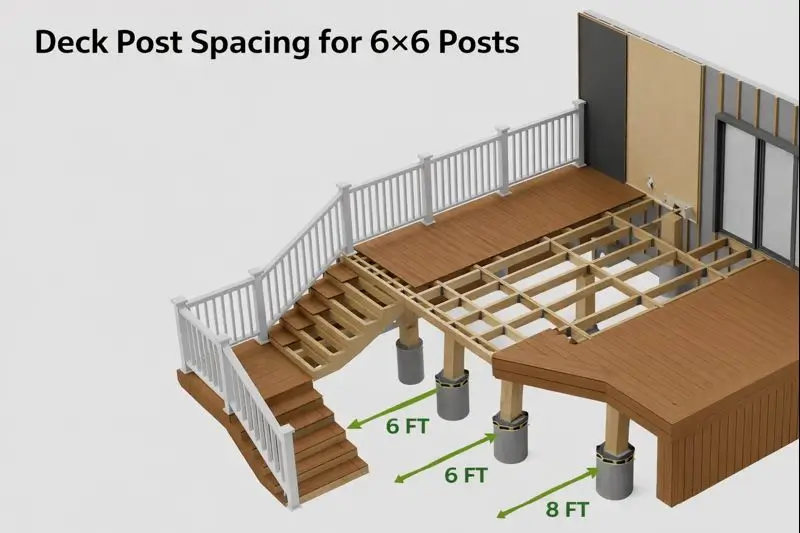
Ask three sources about deck post spacing for 6×6 posts and you’ll likely get three different answers. Eight feet is often quoted as the standard. Six feet shows up in more conservative designs. And occasionally someone claims they stretched it much farther with no consequences.
What’s usually missing from those answers is context. Spacing 6×6 posts isn’t about picking a number—it’s about how loads move through the deck, how beams span between supports, how tall the structure is, and what the ground beneath it can handle. Ignore those factors and problems tend to show up later, not during the build.
This article lays out how professionals actually evaluate post spacing, using plain language and real-world logic instead of guesswork.
Why 6×6 Posts Changed the Rules
Modern deck codes didn’t always require 6×6 posts. For a long time, 4×4 posts were common. Then decks got bigger, higher, and heavier. Railings failed. Posts twisted. Inspectors pushed back.
Today, most jurisdictions either require or strongly prefer 6×6 posts, especially for structural support. They’re stiffer, resist twisting better, and handle lateral loads far more reliably.
That extra strength is why people assume they can space them farther apart. Sometimes that’s true. Sometimes it absolutely isn’t.
The “8-Foot Rule” (and Why It’s Only a Starting Point)
You’ll see this number everywhere: 6×6 deck posts can be spaced up to 8 feet on center. That guideline comes from common beam span tables and typical residential loading assumptions.
In average conditions—standard deck, moderate height, no special loads—8 feet often works. It’s a clean number, it looks balanced, and it aligns with many beam configurations like double 2×10s.
But “often works” isn’t the same as “always works.”
As soon as you change any of the following, that 8-foot spacing starts shrinking fast:
- Heavier beams
- Hot tubs or concentrated loads
- High snow regions
- Taller decks
- Weak or expansive soil
Spacing posts too far apart doesn’t usually cause dramatic failures. Instead, it creates movement. Slight sag. Railing wobble. Long-term creep. That’s what inspectors and experienced builders are trying to avoid.
Beam Size Is the Real Boss
Posts don’t fail because they’re too far apart. Beams fail first. Post spacing is really beam spacing in disguise.
According to guidance commonly referenced from the American Wood Council and its DCA 6 prescriptive deck guide, here’s how beam size quietly controls your layout:
- A double 2×8 beam usually limits post spacing to just under 7 feet.
- A double 2×10 beam often lands around 8 feet, give or take.
- A double 2×12 beam can approach 10 feet in ideal conditions.
- Triple beams buy you more distance, but only if the posts, footings, and soil keep up.
This is why two decks with identical 6×6 posts can have totally different layouts—and both be correct.
Tributary Area: The Concept Most DIYers Miss
Tributary area sounds technical, but it’s simple. It’s the amount of deck each post is responsible for holding up.
Wider joist spans mean each beam carries more load. Wider beam spacing means each post carries more beam load. Stack those together, and suddenly that post is doing real work.
If you increase:
- Deck width
- Joist span
- Beam span
You should expect post spacing to decrease, even with 6×6 posts.
This is why hot tub decks are a different animal entirely.
High-Load Situations Change Everything
If your deck will support a hot tub, masonry fireplace, outdoor kitchen, or sits in a heavy snow zone, standard spacing doesn’t apply.
In these cases, 4 to 6 feet on center is common, even with 6×6 posts. Not because the posts are weak, but because the system as a whole needs stiffness.
Snow load alone can add 30–70 pounds per square foot depending on region. That load doesn’t announce itself until winter, when it’s already too late to fix poor spacing.
Railing Posts: Same Lumber, Different Rules
Using 6×6 posts for railings feels like overkill, but it’s increasingly common—and for good reason.
Railing posts must resist a 200-pound concentrated load at the top, applied outward. That’s not a lot… until someone falls into it sideways.
Most codes allow 6×6 railing posts to span up to 8 feet, but many builders tighten that to 6 feet for feel alone. A railing that technically meets code but flexes under hand pressure still feels wrong.
Even spacing also matters visually. Three 5-foot sections usually look better than one 8-foot run followed by an awkward short bay.
Height Creates a New Problem: Sway
As decks get taller, vertical strength stops being the concern. Lateral movement takes over.
A short 6×6 post is incredibly stiff. A tall one behaves more like a lever.
Once you get past a few feet above grade, knee bracing starts to matter. Diagonal braces at 45 degrees between post and beam dramatically reduce sway, especially in wind-prone areas.
This is one reason 6×6 posts are commonly allowed to reach heights that 4×4 posts never could—but only with proper bracing.
Footings: The Quiet Failure Point
A strong post on a weak footing is still a weak system.
Most 6×6 deck posts require footings at least 12 inches in diameter, and often 16 to 18 inches depending on load and soil. Depth must extend below the frost line, which can mean 36 inches or more in colder climates.
Posts should sit on approved post bases, not embedded directly in concrete. A small standoff keeps moisture from wicking into the end grain and silently rotting the post from the bottom up.
Hardware matters here. Builders often rely on connectors from manufacturers like Simpson Strong-Tie, not because they’re fancy, but because inspectors trust tested systems.
Wood Species Isn’t Just Trivia
Not all 6×6 posts perform the same.
Southern Pine and Douglas Fir are common structural choices because of their strength. Cedar is popular for appearance, but it’s softer. A high-grade cedar post can still work structurally, but it doesn’t buy you extra spacing.
Span tables assume specific species and grades. Swapping materials without adjusting spacing is a quiet way decks get underbuilt.
What Inspectors Actually Look For
Inspectors rarely measure spacing with a tape and walk away. They’re looking at:
- Beam size vs post spacing
- Footing size vs tributary load
- Connection methods
- Overall stiffness and bracing
If something “feels” underbuilt, it usually is—even if one number technically passes.
The Practical Takeaway
For most residential decks, 6×6 post spacing lands between 6 and 8 feet on center. Eight feet is common, clean, and often acceptable. Six feet is conservative, stiff, and rarely questioned.
When in doubt, tighter spacing almost never causes problems. Wider spacing sometimes does—just not right away.
If you want a deck that feels solid ten winters from now, don’t ask how far apart posts can be. Ask how far apart they should be for your specific deck.