
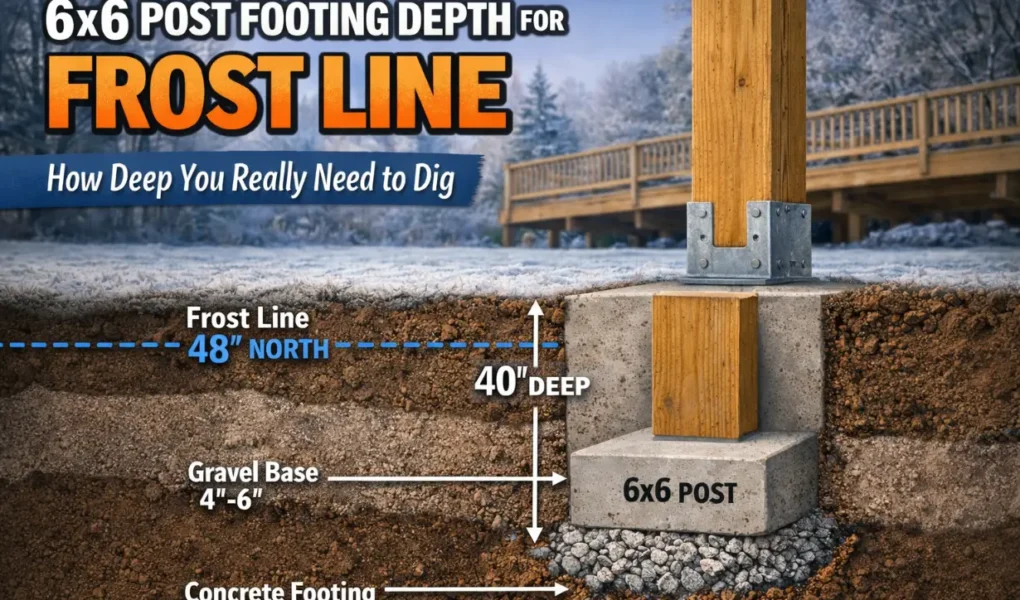
If you’ve ever tried to look up 6×6 post footing depth for frost line, you’ve probably noticed how quickly the advice turns messy. One site says 12 inches is fine. Another insists on 48 inches. Someone in a forum swears they’ve “done it this way for 20 years with no problems.” None of that helps when you’re standing in your yard with an auger, cold hands, and a building inspector who definitely cares.
So, let’s slow it down and talk through this the way a builder actually would—plain language, real-world context, and no pretending there’s a one-size-fits-all answer.
Why frost line depth actually matters for 6×6 posts
Frost heave is the whole reason this conversation exists. When soil freezes, it expands upward. If your footing sits above that freeze depth, the ground can literally grab the concrete and lift it. Once that happens, posts tilt, decks slope, and fences start looking like they’re melting.
A 6×6 post carries more load than smaller posts, so the footing underneath it has to resist two things at once: downward weight and upward frost pressure. The only reliable way to do that is to place the bottom of the footing below the frost line, where soil temperature stays stable year-round.
That’s the non-negotiable rule. Everything else is adjustment.
Typical frost line depths across the U.S.
Frost depth isn’t random. It’s driven by climate, soil moisture, and historical freeze data, and most local building departments already know their numbers.
In broad terms, southern states often have frost lines around 12 inches or less. Mid-Atlantic and central regions usually fall between 24 and 36 inches. The Midwest commonly requires 36 to 48 inches, and northern states can exceed 48 inches, sometimes pushing 60 inches in colder or higher-elevation areas.
That’s why advice you see online feels contradictory—it’s usually correct for someone, just not necessarily for you.
Local codes often require footings to extend at least 12 inches below the local frost line, not just to it. Inspectors like margin, and honestly, so should you.
The real-world depth for a 6×6 post footing
If you want a practical answer builders use, it’s this: Dig to the frost line, then go another 3 to 4 inches.
That extra depth allows room for a gravel base and ensures the concrete footing itself—not just the bottom of the hole—sits below the freeze zone. For example, if your frost line is 36 inches, your hole will likely end up around 40 inches deep.
There’s also a structural rule of thumb that still matters even in warmer climates: the hole depth should be at least one-third of the post’s total above-ground height. A six-foot fence post still benefits from a two-foot footing, even if frost isn’t a concern. Wind load doesn’t disappear just because winters are mild.
Footing diameter matters as much as depth
Depth gets all the attention, but width is what keeps posts from leaning.
For a standard 6×6 post (actual size 5.5 by 5.5 inches), most builders land in the 12 to 16 inch diameter range. For heavier loads—like decks, pergolas, or roofed structures—18 inches is a safer and increasingly common choice.
Why? Because wider footings spread the load over more soil and resist lateral forces like wind, shifting ground, and seasonal moisture changes. If you’ve ever seen a deck post lean even though it was deep enough, it was usually under-sized, not under-dug.
Square footings are also acceptable. A 16×16 inch square footing performs roughly the same as an 18-inch round pier in typical soils.
Concrete thickness and footing shape
At the bottom of the hole, the concrete footing itself should be thick enough to actually act like a footing—not just a plug of concrete.
Most codes and builders aim for 6 to 12 inches of concrete thickness at the base. Heavier structures benefit from the full 12 inches, especially when soil bearing capacity is questionable.
A detail many DIY guides skip is footing shape. A flat bottom on undisturbed soil is essential. Even better is a slightly widened or “belled” bottom, where the base flares out wider than the shaft. This shape resists frost heave by giving the soil less leverage to push upward.
It’s one of those small upgrades that makes a big difference long-term.
Soil bearing capacity and why codes assume the worst
Footing size is technically calculated using load divided by soil bearing capacity. In practice, most residential projects don’t run formal calculations unless required by an engineer.
That’s because building codes, including the International Residential Code, assume a conservative soil bearing capacity—often around 1,500 pounds per square foot—unless proven otherwise. This protects against clay soils, poor drainage, and unknown fill.
For example, if a post carries 4,000 pounds and the soil supports 1,500 psf, you need roughly 2.7 square feet of footing area. That works out to about an 18-inch diameter footing, which explains why inspectors like that number so much.
Gravel base: optional in theory, essential in practice
Technically, concrete can be poured directly onto undisturbed soil. Practically, that’s rarely the best choice.
A 4 to 6 inch layer of compacted gravel at the bottom of the hole improves drainage and reduces water buildup under the footing. Less standing water means less frost action and less long-term movement.
This is especially important in clay or silty soils, where water drains slowly and freeze-thaw cycles are more aggressive.
Should a 6×6 post be buried in concrete?
This is where opinions get strong.
Direct burial works structurally, but it’s rough on wood. Water tends to collect at the concrete-to-post interface, accelerating rot. Even pressure-treated lumber doesn’t love that environment long-term.
A better approach is pouring the concrete footing to grade and using a galvanized standoff post base, like those commonly made by Simpson Strong-Tie, to keep the wood about an inch above the concrete. It dramatically improves post lifespan and is widely accepted by inspectors.
If burial is unavoidable, the post must be rated for ground contact (UC4B), and any cut ends should be field-treated. Skipping that step is one of the fastest ways to shorten the life of a post.
Concrete volume and planning ahead
For budgeting and logistics, a single 6×6 post footing typically takes 2 to 4 cubic feet of concrete, depending on depth and diameter. That usually translates to four to six standard 80-lb bags per hole.
Digging deeper than required is rarely wasted effort. Re-digging after a failed inspection always is.
Local code still wins, every time
No article—including this one—overrules your local building department. Frost lines can vary within the same state, especially near coastlines, mountains, or urban heat zones.
If there’s ever a conflict between general guidance and your local code, the local code wins. Inspectors aren’t being difficult; they’re working from data specific to your area.
A quick call or permit check before digging can save days of rework.
Final thoughts from someone who’s seen posts fail
When a 6×6 post moves, it’s almost never because someone dug too deep. It’s because they stopped at the minimum, skipped drainage, or underestimated lateral forces.
If you’re asking about 6×6 post footing depth for frost line, you’re already on the right track. Dig below the frost line, give yourself a little extra depth, use enough width, manage water, and don’t rush the concrete work. Those choices don’t show on day one—but ten winters later, they absolutely do.